Continuing the LoRa Story
Well then, as I mentioned in the previous blog, there was an idea — and even some groundwork — to start a project with LoRa.
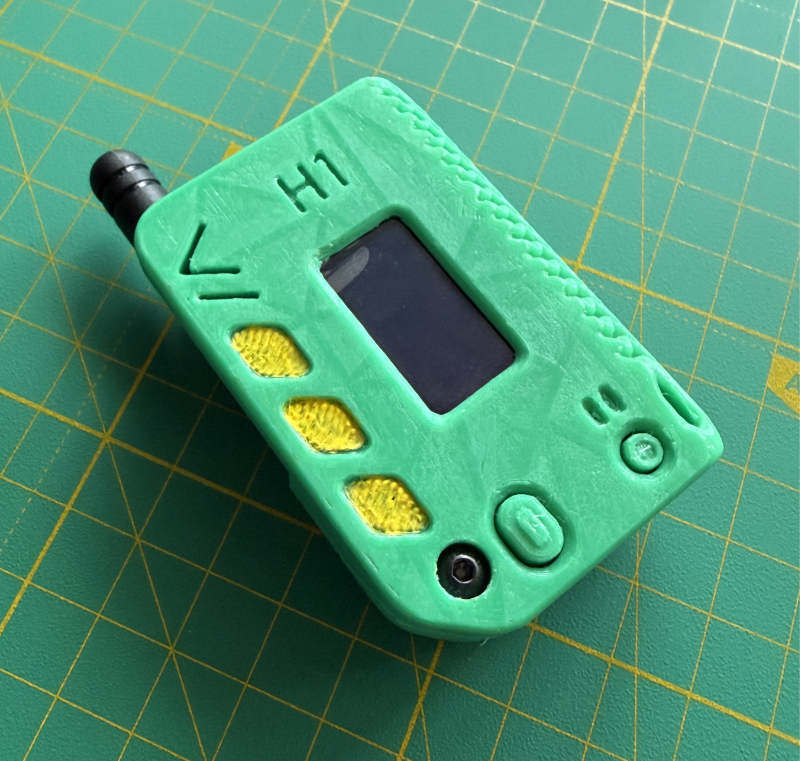
First, everything had to be placed inside the case so that it would all fit, and so that the battery would fit too. Good thing the first stage was still just to connect everything and hope it would turn on — and that stage was successful. But when it came to the enclosure, it turned out that the battery did not fit properly. I had to look for another case, or at least another back cover. Luckily, such an option was found. Trim a little, clean up a little, touch up a little — and it was ready. You could already call it a product.
Now it was time to connect everything to Meshtastic. It turned out to be a pretty simple operation. A lot of people have already done this, and the process is very well established. You simply need to install the app on your phone and start looking for nearby nodes. When the connection via LoRa happens, a verification code appears to make sure you are adding exactly the device you need — and that is it.
The app is very convenient: it allows you to send messages from one device to another, shows device locations on the map, and displays signal strength. Overall, in terms of functionality, it is almost no different from any messenger. You can send messages in both Ukrainian and English — everything works. True, if you send messages in Ukrainian, then on the display of the device itself — yes, the Heltec V3 has a small screen for configuration and messages — the text, unfortunately, is shown as little boxes. But if you send messages in English, everything is fine. Maybe this can be fixed somehow, but for now it is not critical, because everything works normally in the app.
Next — the interesting part. When it came time to decide which option was better, two variants were considered: 868 MHz or 433 MHz. Here you need to be very careful and choose the frequency that is popular and permitted in a specific area. In our case, the chosen option is either not very popular, or almost no one is using it right now, or we need to understand the Meshtastic map better. At least for now, it does not show anyone.
Although that is not a problem, because the idea was to design the device as a way to communicate over long distances when there is no connection. And it performs that function very well.
What is next? Next come the unexpected little problems. It turned out that when you connect it to the phone, the battery actually drains quite quickly. Maybe it is not that critical, but with a 1000 mAh battery, the expectation was that the device would work for longer than one day. Again, maybe the settings need to be changed, or the network needs to be configured differently. For now, that is still unknown.
So what is the plan from here? Hmm, as already mentioned, the device itself has a little screen, so it might be possible to try making it independent from the phone by adding a keyboard to it and maybe something else as well. We will see what comes of it.
- LORA assembled into a working device
- Connection to Meshtastic
So this is not the end of the story — there will be a continuation soon enough.

 Keyboard, Buzzer, and New Antennas